|
||
|
27 November 2026
A step-ladder, a roulette wheel, doctors and trees |
||
|
Hey Dad, how’s your week been? Well, Morganne, it’s Friday again! And here we are, almost at the end of November. Where on earth has this year gone? What a week it’s been! We’ve had some wonderful conversations with clients, a few difficult ones, more people wanting to join the Silke family, and quite a bit of progress with Dash. And somewhere along the way, I’ve been thinking about a step-ladder, a roulette wheel, doctors and family trees! Quite what those four things have in common, I’m still trying to work out. But that’s half the fun, isn’t it? Sometimes I see things in picturesYou know, Morganne, I’ve always been fascinated by patterns. I can look at a graph or a picture and suddenly something catches my attention. I start wondering why it’s happening, whether there’s a relationship I haven’t considered, and before long I’m off exploring another idea. This week, I found myself thinking about Georgia’s investment portfolio. As you know, she’s been steadily building her investments, and we’ve been looking at how her regular contributions influence the growth of her portfolio. But something interesting happens as an investment grows. In the beginning, the money you’re contributing each month can make a significant difference to the total value. As the portfolio becomes larger, however, the movements in the investment markets can eventually exceed those monthly contributions. The portfolio hasn’t necessarily become riskier. It’s simply grown to a point where the rand value of normal market movements can be greater than the amount being added. And I started wondering where that crossover occurs. I imagined it almost like a step-ladder, with each contribution taking you another step higher, until eventually the movements in the investment itself become more noticeable than the steps you’re taking. I’ve been calling this observation my volatility replacement ratio. I even started playing around with a little formula to see whether I could measure the relationship. VRR = C ÷ (V × σ) Where C represents the regular contribution, V the portfolio value and σ the volatility over the corresponding period. In simple terms, I’m comparing how much we’re contributing with the size of a typical market movement. Now, I’m quite sure somebody has explored something similar before, and I still need to investigate it properly. It’s an observation rather than an established investment measure. But that’s what I enjoy. Sometimes you discover something for yourself, only to find that somebody else has already given it a name! And that brings me to the roulette wheel! A roulette wheel and the illusion of certaintyWe’ve spoken before about my fascination with systems, probabilities and trying to understand how things work. Roulette is an interesting example. You can study the numbers, observe patterns and develop all sorts of theories about what might happen next. But none of that changes the fundamental uncertainty of an independent spin. And I think there’s an interesting distinction between understanding uncertainty and believing we’ve found a way to eliminate it. The same applies to investments. We can study markets, construct diversified portfolios, manage risk and make informed decisions. But we can’t control the outcome. And perhaps that’s one of the most important things experience teaches us. Not that we eventually discover all the answers, but that we become more comfortable recognising what we don’t know.
Because once we’re absolutely convinced we’ve got something figured out, we tend to stop asking questions. And that would be rather boring! From a young doctor to retirementSpeaking of different experiences, we’ve had some fascinating client conversations this week. One was with a young doctor preparing to begin her professional career. Her first proper salary, medical aid, insurance, saving for a home and the beginnings of what will hopefully be a long and rewarding financial journey. It’s an exciting stage of life. But there’s also so much uncertainty. How much should she save? How much should she spend? What should she prioritise? And how does she balance enjoying life today with preparing for tomorrow? Then, in another meeting, we were discussing almost the opposite situation. A client approaching retirement, having sold a property, considering how best to invest the proceeds, provide additional income and perhaps help the next generation establish themselves. Two people at very different stages of life. And yet, in both conversations, we kept coming back to the same question. What are you actually trying to achieve? Not simply what investment should you buy, or what return should you expect. What do you want your money to make possible? Because the answer changes depending on where you are in life. And sometimes it changes because life itself has changed. When the conversation becomes more important than the investmentWe’ve also had some difficult conversations this week. One of our clients received serious health news, and we’ve been helping with the practical matters that follow, including insurance claims and medical aid considerations. It’s moments like these that remind me why our relationships with clients extend beyond their investments. A person can have a beautifully structured financial plan, but when something unexpected happens, what matters immediately may be knowing whom to phone and having somebody help with the next step. We’ve been looking at how to incorporate these situations into Dash. Not simply creating a task and ticking a box when it’s completed. But remembering to follow up, recording what’s happened, and making sure somebody takes responsibility for the things that need attention. It’s interesting how technology can help us become more organised. But I don’t want us to become so organised that we forget the person we’re organising everything around! And then there’s our family tree!Something else rather exciting happened with Dash this week. We’ve been developing the family-tree functionality, and I was looking at our own family as an example. There we were! Carolyn, you, Georgia, me, and the generations before us. Parents, grandparents, marriages, relationships and family members who are no longer with us. All connected in one picture. 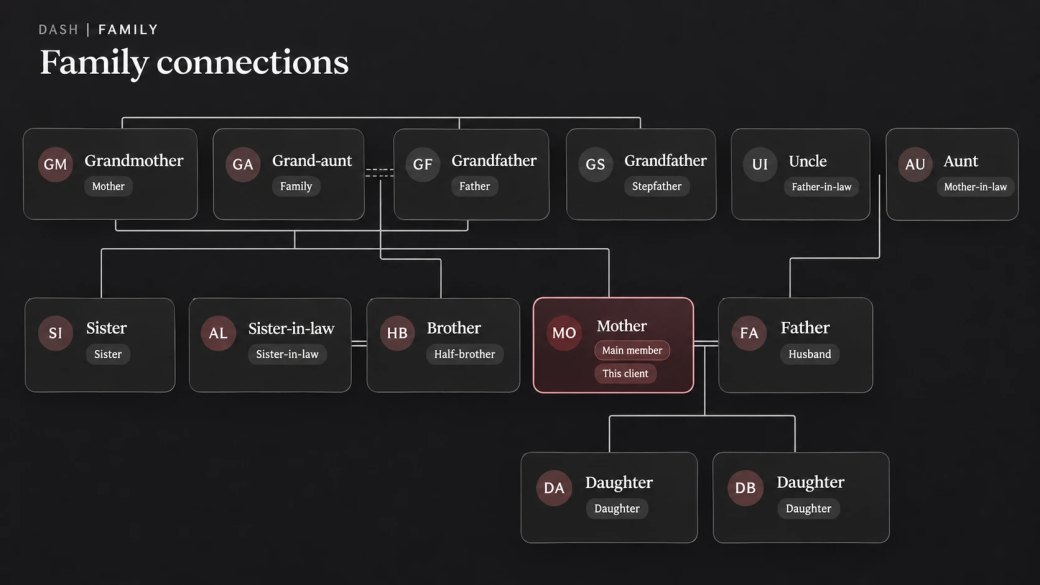
Now, you might wonder what a family tree has to do with financial planning. Quite a lot, actually. When we work with families, we’re not simply dealing with individual investment accounts. We’re dealing with people who are connected to one another, often across several generations. A decision made by one person can influence the circumstances of somebody else. And understanding those relationships can help us provide more thoughtful advice. But I must say, Morganne, seeing our own family represented on that screen was rather special. We’ve spent so much time talking about building a family-office approach to Wealthcare. And now we’re beginning to see some of those ideas take shape. There’s still an enormous amount to do, and I’m sure Ryan, Tiaan and the team will tell me there are a few more complications than I originally imagined! But we’re making progress. And I’m enjoying watching it develop. So, Morganne, what did I learn this week?I’ve been thinking about something we discussed recently. How often do we believe we’ve developed an idea entirely by ourselves, only to realise how much our experiences and the people we’ve encountered have influenced our thinking? I look back at some of the things I’ve learnt over the years, particularly the importance of understanding people’s values, their goals and what motivates them to change their behaviour. Those experiences have had an enormous influence on how I approach financial planning. And the more I reflect on them, the more I realise that learning doesn’t happen in isolation. We learn from our families, our clients, our mistakes, our successes and sometimes from the most unexpected conversations. A young doctor beginning her career. A client making decisions about retirement. Georgia’s investment graph. A roulette wheel. And even a family tree on a computer screen. Different experiences, different questions, and occasionally a connection that I hadn’t noticed before. Which brings me back to something I’ve always enjoyed. Research your own experiences for truth. Not because your experiences necessarily give you all the answers. But because they give you somewhere to begin asking questions. And perhaps that’s what I enjoy most about these Friday conversations with you. I’m not simply telling you what I’ve learnt. I’m still learning myself. And it’s rather wonderful having somebody to share the discoveries with. Anyway, Morganne, that’s enough thinking for one Friday! We’ve got another rugby weekend ahead of us, and after all the shenanigans of the past few weeks, I’m hoping we can simply enjoy a good game of rugby and let the best team win. Although I suspect we’ll all have something to say about the referee by Monday! And can you believe December is almost here? The holidays are approaching, everybody’s trying to finish off the year, and there’s still plenty to do! But that’s a conversation for another Friday. Have a lekker, lekker weekend! Love, 
Shane Thom, CFP® GTP(SA)™ 🏉🏆🏆🏆🏆 |



Editor: Shane Thom, Silke Financial Services FSP No. 12462 · An Authorised Financial Services Provider Copyright © 2026 by Silke Financial Services CC – All Rights Reserved. |