| ← All communiqués |
|
||
|
22 December 2016
The Bear, the Monkey, the Turkey, and the Bull |
||
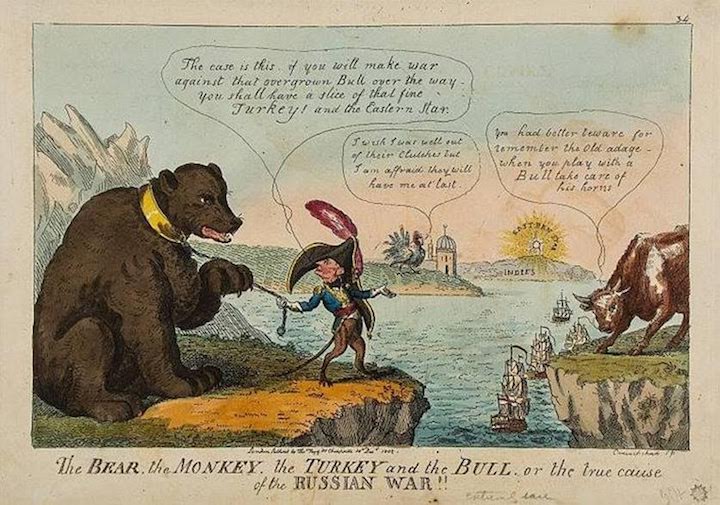
From a caricature by Isaac Cruikshank of Dec. 1807, The Bear, the Monkey, the Turkey, and the Bull. "Most, probably, of our decisions to do something positive, the full consequences of which will be drawn out over many days to come, can only be taken as the result of animal spirits - a spontaneous urge to action rather than inaction, and not as the outcome of a weighted average of quantitative benefits multiplied by quantitative probabilities." - J.M.Keynes, General Theory. The term was chosen to emphasise the importance of confidence and the ‘gut instincts’ of businessmen on their future business prospects. Well what has the above got to do with us? Keynes explained that, given fundamental uncertainty, rationality alone is insufficient to justify action. By understanding what is influencing (psychological) you to action (behaviour) needs to be explored. Can 'market irrationality' being reported in the media (internet, financial blogs, or on social media) influence action? Knowing your preferences within the SCARF model can help you:
The SCARF paper (first published in 2008) draws on extensive social neuroscience studies to propose a simple framework. Briefly, social neuroscience studies how and which parts of the brain react to different types of stimuli related to social interactions. There are two overarching principles. First, our motivation driving social behaviour is governed by the will to minimize threat and maximize reward. Second, social needs are treated in much the same way in the brain as the primary needs such as food and water. What is the best investment for you as the year draws to a close? "Learn to work harder on yourself than you do on your job" 
One day Mr. Shoaff said, "Jim, if you want to be wealthy and happy, learn this lesson well: Learn to work harder on yourself than you do on your job." Since that time I've been working on my own personal development. And I must admit that this has been the most challenging assignment of all. This business of personal development lasts a lifetime. You see, what you become is far more important than what you get. The important question to ask on the job is not, "What am I getting?" Instead, you should ask, "What am I becoming?" Getting and becoming are like Siamese twins: What you become directly influences what you get. Think of it this way: Most of what you have today you have attracted by becoming the person you are today. I've also found that income rarely exceeds personal development. Sometimes income takes a lucky jump, but unless you learn to handle the responsibilities that come with it, it will usually shrink back to the amount you can handle. If someone hands you a million dollars, you'd better hurry up and become a millionaire. A very rich man once said, "If you took all the money in the world and divided it equally among everybody, it would soon be back in the same pockets it was before." It is hard to keep that which has not been obtained through personal development. So here's the great axiom of life: To Have More Than You've Got, This is where you should focus most of your attention. Otherwise, you just might have to contend with the axiom of not changing, which is: Unless You Change How You Are, You'll Always Have What You've Got. To Your Success, Regardless of how you choose to invest, you should be doing it right now. Our integrated wealthcare approach is based on your personal priorities and aspirations. This process is designed to give you a clear course of action for pursuing your goals that span various time horizons and life stages to empower you to do extraordinary things with your wealth, both now and in the future. Regards, Shane Thom, CFP® GTP(SA)™  |



Editor: Shane Thom, Silke Financial Services FSP No. 12462 · An Authorised Financial Services Provider Copyright © 2016 by Silke Financial Services CC – All Rights Reserved. |