| ← All communiqués |
|
||
|
2 February 2016
Launch of the Silke Tax-Free Savings Accounts |
||

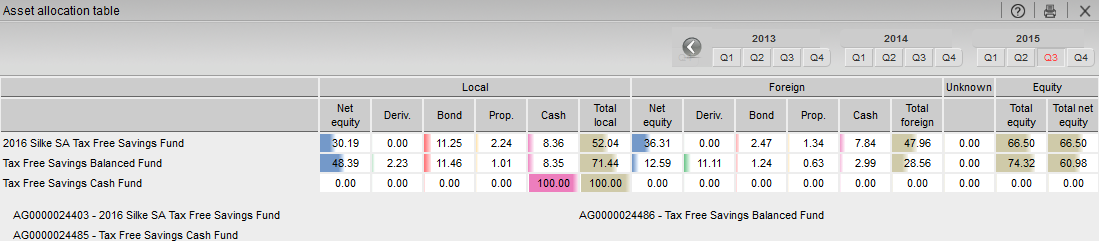
We are pleased to inform you that we now can offer tax-free savings accounts through the Allan Gray Platform. What is a Tax-Free Savings Account? The Tax-Free Investment Account was introduced by National Treasury to encourage individuals to save with the benefit of the account being 100% tax free. These accounts came into effect on 1 March 2015. The investment account is exempt from income tax, capital gains tax (CGT) and dividend withholding tax. Individuals are allowed to contribute R30 000 per year to a tax-free savings account and there is a lifetime maximum contribution limit of R500 000. By using a tax-free investment one could generate meaningful value compared to a basic unit trust investment invested in over the very long term. The potential after 16 years could be as much as an extra 30%, driven by the value of compounding all interest and gains, tax free. One has unrestricted access to the market value of the investment without any penalties or withdrawal fees. Amounts withdrawn cannot be replaced without making use of the contribution limits, i.e. a withdrawal from a tax-free investment will not increase an investor's annual and lifetime limit. The Tax-Free Investment Account will be structured as a life policy. Investors may nominate one or more beneficiaries. When the investor dies, the market value will be paid to beneficiaries immediately. The value will be included in the deceased's estate for estate duty purposes, but no executor's fees will be incurred. What You Need to Know: To maximise the full benefit of the Tax-Free Investment Account, time in the investment is critical. We believe that the Tax-Free Investment Account should ideally be used for long-term discretionary investments allocated to retirement. If you contributed the maximum allowed amount every year, it will take 16.67 years to reach your lifetime maximum contribution limit. One can invest in the Tax-Free Investment Account either via a lump sum or a debit order. The monthly debit order is capped at R2 500 per month to prevent exceeding the annual contribution limit. Exceeding these limits will lead to a hefty 40% penalty from SARS. The Tax-Free Investment Account is available to individual investors of any age. One can only open a single tax-free investment account in your own name, but you may open additional accounts in the names of other investors, e.g. children. Why Invest in a Tax-Free Investment Account? The Tax-Free Investment Account, after 16.67 years, should grow to a substantial amount. Used correctly, regular withdrawals can reduce taxable income triggered from interest, annuity and capital gains tax income. Further to this - one could plan for the capital to be exhausted at a specific age, for example age 90, allowing for investments in retirement products (which escape estate duty) to grow, driven by the value of compounding due to a lower drawdown required. Before jumping full steam into this product, one should consider weighing up contributions into a retirement annuity versus the Tax-Free Investment Account. The general view is that the Tax-Free Investment Account should complement, not replace, retirement savings. New retirement fund deduction rules will take effect on 1 March 2016, increasing the deduction cap to 27.5%. When deciding to invest in the Tax-Free Investment Account, the portfolio objective should be to allocate long-term discretionary investments to retirement. The aim of a tax-free investment would be to generate the maximum possible investment return. The investment should therefore allow for a non-restrictive Tactical Asset Allocation strategy. Tactical Asset Allocation allows for greater investment flexibility, with no local and global investment restrictions, as opposed to balanced funds. Most balanced funds in South Africa are regulated by Regulation 28 of the Pension Funds Act (25% in property / 25% in offshore assets / 75% in equities). Due to the annual tax-free interest allowance, investing in cash via the Tax-Free Investment Account, in most cases, wouldn't be recommended. Where is the money invested? It is highly recommended that you consult with your independent financial advisors, prior to making any Tax-Free Investment decisions. The Silke SA Tax Free Investment: We believe that the Silke SA Tax Free Investment is most suitable for investing in the Tax-Free Savings Account. The current global tactical asset allocation is targeted at a minimum of 30%. Allocating a portion of the investment globally spreads the risk across different businesses, economies, geographic regions and provides the potential for increased returns, as opposed to cash and restricted funds. This investment therefore does not conform to regulation 28. Past performance is no indication of future performance. No guarantees are provided. How will the fund perform over my time horizon? See the performance summary here This fund is most suitable for a person who understands the concept of "time diversification" and has a long term investment outlook. This person understands and appreciates that markets can be volatile and will not redeem investments during periods of weak markets, is comfortable with market fluctuation i.e. high volatility, and will not redeem such investments during periods of weak markets. The deadline to invest in the 2015/2016 tax year is 14:00 on Friday, 26 February 2016. If you would like to invest in the Silke Tax-Free Investment before the end of the tax year, please contact us before the deadline. Please note that EFTs will not be allowed - to ensure that you do not exceed the contribution limits in your Tax-Free Investment, money will be collected from your bank account via a direct debit. Our integrated wealthcare approach is based on your personal priorities and aspirations. This process is designed to give you a clear course of action for pursuing your goals that span various time horizons and life stages to empower you to do extraordinary things with your wealth, both now and in the future. Regards,
Shane Thom, CFP® GTP(SA)™ |



Editor: Shane Thom, Silke Financial Services FSP No. 12462 · An Authorised Financial Services Provider Copyright © 2016 by Silke Financial Services CC – All Rights Reserved. |