| ← All communiqués |
|
||
|
21 November 2014
South Africa's Reserve Bank left interest rates unchanged at 5.75 percent |
||
|
The South African Reserve Bank has unanimously decided to keep the repo rate on hold - at 5.75%, given "the lower trajectory of headline inflation and continued weak state of the economy." A number of economists had predicted that the repo rate would remain unchanged, given the more moderate inflation outlook and downside risks to South Africa's economic growth. Investec economist Kamilla Kaplan said on Wednesday that she expected the repo rate would not be changed at the January 2015 MPC meeting either. New Sarb governor Lesetja Kganyago said the timing of future interest rate increased would depend on the "evolution of inflation expectations, the speed of normalisation of monetary policy in the US and the state of the domestic economy". He added that the MPC remained of the view that interest rates would have to normalise over time. This is the process through which monetary policy decisions affect the economy in general and the price level in particular. The transmission mechanism is characterised by long, variable and uncertain time lags. As such it is difficult to predict the precise effect of monetary policy actions on the economy and price level. However, to be successful in conducting monetary policy, the monetary authorities must have as accurate an assessment as is possible of the timing and effect of their policies on the economy, thus requiring an understanding of the mechanisms through which monetary policy affects the economy. The chart below provides a schematic illustration of the main transmission channels of monetary policy decisions: 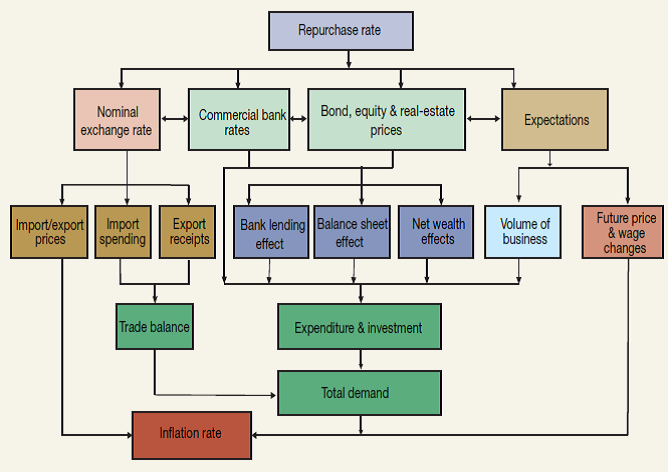
Source: Box 3, Monetary Policy Review, May 2004 Rationale for a financial stability focus. The ultimate objective of economic policy is to create a sustainable level of economic growth through investment, employment and production. This is best achieved when contributions are made from all sectors in the economy. Historically the financial sector has made substantial contributions to the level of economic growth. The responsibility for ensuring healthy contributions from this sector towards sustainable economic growth, are generally split between three parties. Firstly, government's responsibility is to create a stable environment and infrastructure of legal rules and practice and timely, accurate information, supported by regulatory and supervisory arrangements that help ensure constructive incentives for financial market participants. Success will promote growth and stabilise the economy on a higher growth path. Secondly, the central bank is responsible for contributing towards the achievement and maintenance of a stable financial system. Thirdly, the environment and conditions created by the government and the central bank will enable the private sector to create economic growth through investment, employment and physical production. For many years, central banks have focussed primarily on their monetary policy (price stability) objective. However, the Great Recession that began in 2007 has seen a rethink, with an increased emphasis on financial stability. The relationship between monetary policy and financial stability is important, not only in looking at what monetary policy, or monetary policy tools, can do about financial stability issues but central banks must also ensure that monetary policy actions themselves do not promote financial instability. For example by keeping interest rates too low because inflation is within the target, such that these low interest rates in turn generate an asset price bubble. The increasing interdependence of economies and interconnectedness of the global financial system has led to significant financial stability initiatives. These structured initiatives have developed standards that are material to the strengthening of the global financial system. Furthermore, the cost of the recent financial crisis has been significant. According to the International Monetary Fund (IMF) direct costs of banking crises in the past 15 years exceeded 10% of the GDP in more than a dozen cases. A concerted effort through various international bodies has seen agreement on common standards and principles for financial regulators. This has also resulted in central banks focussing more closely on financial stability and macro prudential analysis. |



Editor: Shane Thom, Silke Financial Services FSP No. 12462 · An Authorised Financial Services Provider Copyright © 2014 by Silke Financial Services CC – All Rights Reserved. |