| ← All communiqués |
|
||
|
October 2014
Investor Behaviour: you're influenced more than you think |
||
|
Why do we tend to follow the crowd? It feels easier and safer even if it isn't. 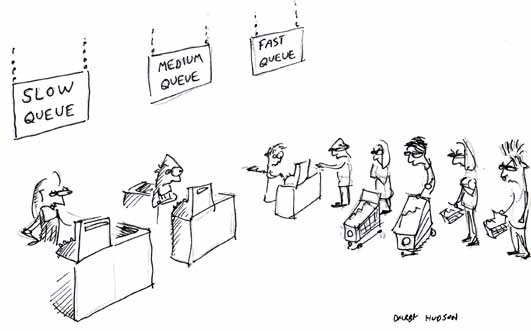
I saw the above cartoon in a blog I read recently "Why do we as humans often make illogical decisions?" by Chris Inifer, Allan Gray Australia. Chris states: "The above cartoon proves a simple (and often amusing) human truth: We are all susceptible to following the crowd. We often don't even realise that we are doing this. It is human behaviour to look for visible and easy to understand prompts to help us make decisions. In this example, the 'easy prompt' is the sign saying 'fast queue'. Who wouldn't want to be in the fast queue? Why do we find it hard to be different? The more people that join the fast queue, the more valid their behaviour seems and the more we are attracted to do the same. However, 'valid' is not necessarily best or optimal. The irony in the cartoon proves this, as people will actually end up spending a lot more time in the so-called 'fast queue' instead of joining one of the other queues. While it may feel uncomfortable to join a queue labelled 'slow', the price of not doing so and following the crowd would (as shown in the cartoon) actually be a longer wait. This is at the heart of herd behaviour - there is a cost involved. How can 'following the herd' when you invest cost you money? When you invest, following the herd is a poor way to make decisions, because it is more likely to increase your risk and reduce your returns. If a certain share is popular, there will be many willing buyers, and they have to compete with each other to buy it. So the price rises. The higher the price you pay, the lower the prospective return, and the greater the risk you take on. This is a large price to pay for being part of the crowd." Well known behaviourist, Daniel Kahnemann quotes an example where two groups were asked to fill in questionnaires. The questions the one group had to answer were related to "youth", the other group's questions related to "aging". On completion they had to walk to a different hall to answer a second questionnaire. Unbeknown to them, the real purpose of the exercise was to measure the speeds at which the two different groups would walk between the two venues. Believe it or not, the individuals answering questions to do with "aging" walked considerably slower than those dealing with "youth". The thoughts that occupy your mind subconsciously affect your actions! Worse: Without knowing it, we also allow our opinions to be altered by those around us, even though they could be total strangers. The above behaviours and other known biases have made the way investors react to stimuli very predictable. In technical terms: "systematic psychological errors tend to create market inefficiencies" and that "overreaction to bad news often pushes stocks far below their fair value". How do fund managers overcome these biases?
The following quote from Warren Buffett is an excellent antidotes to environmental influences and biases:
As our brains get bombarded by news items on a daily basis, we have a tendency to only see the bad news when markets fall and ignore the bad news when prices go up. Remaining rational is not easy, so what should we do?
Don't allow media manipulation take place without your consent. Those who commit to improving upon their internal condition will be equipped to make the better decisions for themselves, but those who focus on external distractions will be susceptible to the various techniques and strategies of media mind control. The thoughts that occupy your mind subconsciously affect your actions! Regards |



Editor: Shane Thom, Silke Financial Services FSP No. 12462 · An Authorised Financial Services Provider Copyright © 2014 by Silke Financial Services CC – All Rights Reserved. |