| ← All communiqués |
|
||
|
October 2014
It is only natural to have some concerns - so, what does one do? |
||
|
The remarkable turnaround in the equity market since 2008 is noteworthy, yet not unexpected. However the volatility seen in recent months has prompted numerous investment houses to take defensive positions as they feel that in some economies market and liquidity risks have increased to levels that could compromise financial stability if left unaddressed. The October 2014 Global Financial Stability Report (GFSR) finds that six years after the start of the crisis, the global economic recovery continues to rely heavily on accommodative monetary policies in advanced economies. Monetary accommodation remains critical in supporting the economy by encouraging economic risk taking in the form of increased real spending by households and greater willingness to invest and hire by businesses. However, prolonged monetary ease may also encourage excessive financial risk taking. The best way to safeguard financial stability and improve the balance between economic and financial risk taking is to put in place policies that enhance the transmission of monetary policy to the real economy-thus promoting economic risk taking-and address financial excesses through well-designed macro prudential measures. (source: imf.org) So, what's Warren Buffett up to over past few weeks? He is on record on CNN interview 2 days ago stating that he has "been very active during the sell off" and - this is probably hardly surprising bearing in mind he has often said that to be a successful investor you must be "greedy when others are fearful". "I like buying it as it goes down, and the more it goes down, the more I like to buy," the 84 year-old Buffett said during an interview with CNBC last week. Though he wouldn't specify which companies he bought, he claimed they were "names you'd recognize." If you have savings or investments, it is only natural to have some concerns - so, what does one do?
Investment Profile Portfolio Allocation Minimum investment Term Silke Model Portfolio's Long Term Full Equity (Local/Offshore) 10 years Silke MM Offshore Fund (Worldwide-Multi Asset-Flexible) Silke MM Aggressive Fund (South African-Multi Asset-Flexible) Medium Term Asset Allocation [maximum 75% Equity] 5 Years Silke MM Balanced Fund (South African-Multi Asset-Medium Equity) Short to Medium Term Low Equity 2 Years Silke MM Stable Fund (South African-Multi Asset-Low Equity) Short Term Money Market 1 Year Silke Cash Management Fund (South African Interest Bearing Money Market) Short to Long Term Silke Combination of the Silke MM Funds Income for Life Silke MM-Horizon Income Fund (Targeted Real Return Portfolio) .
Do not try and time the market! Often a few very good days account for a large part of the total return. By trying to time the market, one could potentially miss out on market rallies. The chart below shows the relationship between a buy and hold strategy and the effect on your returns should one have missed 30 of the best days during the period: 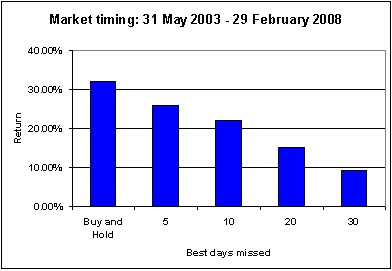
The chart below shows the relationship between a buy and hold strategy and the effect on your returns should one have missed 30 of the worst days during the period: 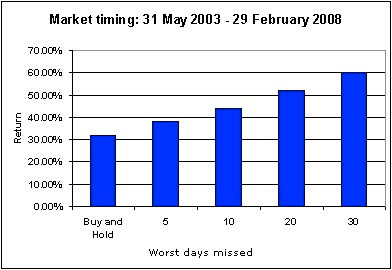
Silke Financial Services - skilled risk and investment strategy consultants that provide a unique service offering not available elsewhere in the marketplace. |



Editor: Shane Thom, Silke Financial Services FSP No. 12462 · An Authorised Financial Services Provider Copyright © 2014 by Silke Financial Services CC – All Rights Reserved. |