| ← All communiqués |
|
||
|
13 August 2014
Economics and The Time Value of Money - Business Cycles |
||
|
According to Henk Pieterse, head of marketing at Allan Gray. Occasionally financial markets become totally obsessed with a particular issue. The same can be said for many investors, who have added the unconventional actions of central banks to their favourite conversation topics, which include the exchange rate, the price of gold and opportunities in emerging markets. While asset prices have been affected by quantitative easing and will most likely be impacted by its end (called 'tapering'), it is very difficult, if not impossible, to predict the long-term impact. Investing based on predictions is inherently uncertain creating distracting clients from their goals, which is to create wealth over the long term. The antidote to distraction is staying focused and understand the principles of the business cycle. Staying focused and committed over the long term is an important part of successful investing. The temptation to change your investment strategy puts your long-term goals in jeopardy. The principles behind the sector rotation strategy fall in line with conventional wisdom: You want to invest in the industries that are anticipated to benefit the most based on what stage of the business cycle the economy is in. Unfortunately, no two business cycles are the same, and knowing exactly where we are in the business cycle is easier said than done. Changes in the business cycle impact the return of securities in different asset classes. The business cycle has four phases:
Phases of the Business Cycle 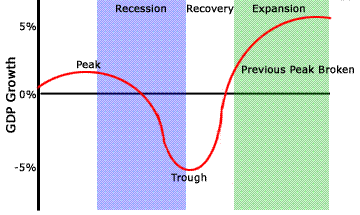
According to the NBER, there have been 11 business cycles from 1945 to 2009, with the average length of a cycle lasting about 69 months, or a little less than six years. The average expansion during this period has lasted 58.4 months, while the average contraction has lasted only 11.1 months. The business cycle can be effectively used to position one's investment portfolio. For instance, during the early expansion phase, cyclical stocks in sectors such as commodities and technology tend to outperform. In the recession period, the defensive groups like health care, consumer staples and utilities outperform because of their stable cash flows and dividend yields. As of January 2014, the last expansion was determined to have commenced in June 2009, the period when the Great Recession of 2007-09 reached its trough (technically, that recession began in December 2007). Expansion is the default mode of the economy, with recessions being much shorter and less common. So why do recessions occur at all? While economists' views differ on this subject, there is a clear pattern of excessive speculative activity evident in the latter stages of expansion in many business cycles. The 2001 recession was preceded by an absolute mania in dot-com and technology stocks, while the 2007-09 recession followed a period of unprecedented speculation in the U.S. housing market. The average length of an expansion has increased significantly since the 1990s. The three business cycles from July 1990 to June 2009 had an average expansion phase of 95 months - or almost 8 years - compared with the average recession length of 11 months over this period. While some economists were hopeful that this development marked the end of the business cycle, the 2007-09 put paid to those hopes. Recessions can extract a tremendous toll on stock markets. Most major equity indexes around the world endured declines of over 50% in the 18-month period of the Great Recession, which was the worst global contraction since the 1930s Depression. Global equities also underwent a significant correction in the 2001 recession, with the Nasdaq Composite among the worst-hit as it plunged almost 80% from its 2001 peak to 2002 low. While the above-mentioned examples could all be powerful investment themes, more often than not, what people like to talk about most is not that important when making long-term investment decisions. It is very easy to be distracted from a proven philosophy and to be tempted into solving a short-term crisis with a reactive response. It is crucial to stick to one's investment philosophy, to create wealth over the long term. Our Integrated Wealthcare Management approach is based on your personal priorities and aspirations. This process is designed to give you a clear course of action for pursuing your goals that span various time horizons and life stages. We believe that with a disciplined goal orientated financial planning strategy focusing on your personal, family and work related goals; financial "wealth" can be attained. There is one certainty in the world of finances - your actions today will have a dramatic effect on your aspired future self and lifestyle that you wish enjoy. With the proper Wealthcare plan, one is encouraged to action - the behavioural change that is required to allow a truly wealthy future. It also assists to rationalize emotions which may have a negative impact on your life. Source: Investorpedia and Allan Gray: Why distraction is the enemy of investing posted on March 3, 2014 in Thought Leaders |



Editor: Shane Thom, Silke Financial Services FSP No. 12462 · An Authorised Financial Services Provider Copyright © 2014 by Silke Financial Services CC – All Rights Reserved. |