| ← All communiqués |
|
||
|
28 March 2014
A Wealthcare Team that truly provide a unique service offering |
||
|
28 March 2014 Markets go through cycles. This may seem obvious but every few years market sentiment finds itself in a space where the direction of the stock market seems so overwhelmingly obvious and secure. Take the last few months. Following on from the tremendous bull market following the market lows of 2003, the JSE has made highs on virtually a daily basis. The question is: 'Is it sustainable?' The dilemma is whether it should influence investment decisions in the short term. Nobody really knows! In his book Winning the Loser's Game, Charles D. Ellis compared the "money game" to war, golf and amateur tennis—essentially, endeavours where the victor isn't necessarily the person who makes the most brilliant plays but the one who makes the fewest mistakes. To overcome this issue we at Silke Financial Services continue to use our ' Time Diversification Investment and Risk Management Strategy' to help clients stay on track in meeting their goals. The process we follow is the Six step financial planning process as prescribed by the Financial Planning Standards setting authorities around the world. Our experienced team lead by Kenny, Shane and Jon understands the complexities of the fund management world. We apply this knowledge alongside a client-first mind-set to improve the outcome for the end investor. We make the use of research tools provided by Allan Gray, Profile Data and an external research team, Fundhouse, to assist us. Research into the most appropriate unit trusts is an ongoing process at Silke Financial Services, being focused on:
A research tool used for example is the Risk/Reward Ratio. A ratio used to compare the expected returns of an investment to the amount of risk undertaken to capture these returns. This ratio is calculated mathematically by dividing the amount a portfolio stands to lose if the price moves in the unexpected direction (i.e. the risk) by the amount of profit the trader expects to have made when the position is closed (i.e. the reward). 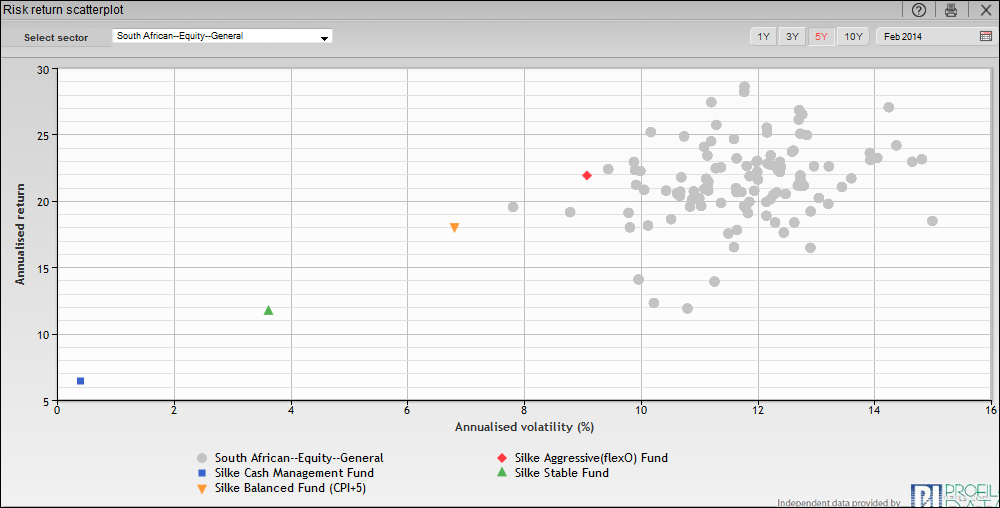
The external ratings system, rates Asset Managers who have a strong preference for qualitative evidence. This is not to say that we completely ignore past fund returns and risk statistics (quants). Rather, it's that we must first establish whether the past returns are a legitimate representation of the current team and approach. Then we can evaluate the track record, once it's validated. The qualitative aspects that would make the track record more reliable are:
Past performance in its raw form is a very poor predictor of future investment success. It is both a poor predictor of future out performance as well as a poor guide to peer relative success. However, where the fund manager has seen very little change to their business, team and process, their ability to repeat past results improves dramatically. The goal of a risk-management program is to ensure that bad outcomes don't knock you out of the game. The strategy, process, experience, tools and research we use helps us maintain a balance among client expectations and accountability. Words from the Wise: 'If you are going to sell every time the stock goes down, you will never win, anymore than a general who always retreats when the enemy advances' - John Train "Silke Financial Services is a skilled Investment and Risk Management Wealthcare Team that truly provide a unique service offering." |



Editor: Shane Thom, Silke Financial Services FSP No. 12462 · An Authorised Financial Services Provider Copyright © 2014 by Silke Financial Services CC – All Rights Reserved. |