| ← All communiqués |
|
||||||||||||||||||||||||
|
14 March 2014
Rand Cost Averaging |
||||||||||||||||||||||||
|
14 March 2014 Albert Einstein allegedly said that compound interest is one the greatest 'miracles' known to man. He was referring to the incredible potential of an investment to grow over time when interest is continually earned upon interest over a long period of time. Similarly, an investment of R10 000 in a South African share portfolio managed by Allan Gray on 15 June 1974 would have grown [before fees] to R142.1 million by 31 December 2013. This explains how wealth can potentially grow and pass through many generations of a family. 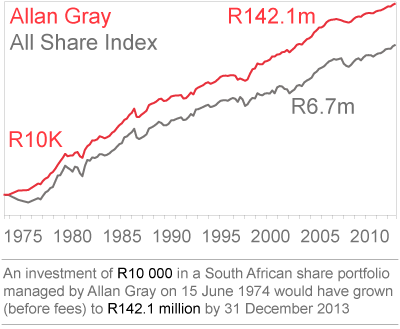
A lesser known, but equally powerful, principle in investing is that of rand cost averaging. Rand cost averaging is an investment strategy involving the regular deposit into a particular investment, at regular intervals, over a period of time. The period could be over several months or even several years. This method of investing can be a powerful risk reduction strategy during times of market volatility or uncertainty, and can help to avoid the pitfalls of attempting to 'time' your entry into investment markets. For example: you place R2 000 a year, for a period of five years, into a unit trust investment. During that period the market falls by 80%, before recovering to its original starting point. At the end of the five years your position would be:
As you can see, your total outlay was R10 000. You now own 2 233 units at R10 each, with a total value of R22 330. Accordingly, your investment has appreciated by 122% over a time when the market has been in a slump. The average cost of your 2 233 units was R4.40 a unit. (R2 233 x R4.40 = R10 000.) However, the real average unit price over the same period was R6.40. How do most investors react in times of market uncertainty? The inclination of many investors during periods of volatility is to 'wait until things settle down'. Some investors try to predict when the bottom of the market has been reached in an attempt to invest at the optimal time. Other investors wait until confidence has returned to the market before investing. Ironically, even when markets do recover, and confidence does return, these very investors wait for the market to fall again before committing to an investment, in the hope of picking up some 'bargains'. Unfortunately, such approaches to investing are flawed, as they lead to what could be termed investor paralysis, resulting in a delay in investing and being unable to fully participate in the benefits of a market that will eventually recover. The principle of rand cost averaging provides a means of reducing the risk of investing during a period of market volatility. It helps to overcome the investor paralysis often associated with falling markets and offers the potential of participating in the purchase of an investment at reduced prices. Silke Financial Services are skilled risk and investment strategy consultants that provide a unique service offering not available elsewhere in the marketplace. |



Editor: Shane Thom, Silke Financial Services FSP No. 12462 · An Authorised Financial Services Provider Copyright © 2014 by Silke Financial Services CC – All Rights Reserved. |