| ← All communiqués |
|
||
|
24 June 2013
The best way to predict your future is to create it! |
||
|
We go to school, learn skills, gain knowledge, study, get a job and start earning money. What's more important, but rarely taught, is the application of money earned to fulfil our basic needs and meet our life goals. It's a well-known fact that vigilant spending, saving and investing, aligned with your goals, is the best way to create your future effectively. As human beings, we do not have an end to dreams and aspirations. Meeting one goal leads to another and usually it's a costlier goal! In this situation it becomes imperative to prioritize our needs and goals. An exercise analysing our various needs and goals will go a long way in getting clarity on what is achievable, by when and how. Prioritizing your needs is the crux of any Need Analysis exercise. Understanding the ‘Hierarchy of Needs in Financial Planning' is handy when undergoing the exercise. The pyramid below depicting the hierarchy has a close resemblance with the popular 'Hierarchy of Needs' by Abraham Maslow in his Theory of Motivation. Note that each level is important and should be concurrently planned for. The stronger the foundation, the easier it becomes to reach the top. 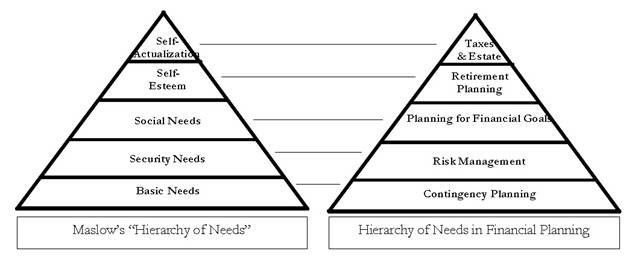
The most basic need our money can meet is taking care of our day-to-day living expenses like food, shelter, clothing, utilities etc. We should be in a position to meet them under any kind of contingencies and emergencies. Contingencies are unforeseen events during our lifetime, which affect our lives and need to be prepared for financially. Contingency planning can be done by creating an emergency fund. Usually the fund size varies from three to six months of an individual's salary or income depending on his/her specific circumstances. This is to ensure that one is able to meet day-to-day family living expenses without any income for a short period of time. Manage your risks. Once you have laid the foundations to meet contingencies you need to protect your income and assets against any kind of loss. An income stops under circumstances like death, permanent or temporary disability and long-term health problems. We need to cover against these income losses. Assurance is a cost, but a necessity taking into consideration uncertainties in life. After assuring your life, one has to cover the physical assets generated during your lifetime. Much of our income is devoted in generating these assets. Any loss demands replenishment which could be a very costly affair and affects our other commitments in life. Invest in yourself. Believe it or not, YOU are your biggest income producing asset. Your net worth is not based on how much money you have, but also on your human capital. Your ability to earn an income. Think of human capital as assets specific to each person, such as your health, intelligence, education, specialized skills, work ethic and social skills in the workplace. So to survive in a world of long-term high unemployment, we should not take our human capital or jobs for granted. "What do you want to do with the rest of your life?" You'll probably do your best work if you're doing what you enjoy the most. Plan your Financial Goals. Financial goals here can be seen at two levels. 1) Commitments (needs) as the primary goals. 2) Dreams and aspirations (wants) as the secondary goals. Commitments are usually family oriented and include providing decent accommodation for family, children's upbringing and education, taking care of parents etc. Then come dreams and aspirations (my yellow submarine). One must dream, they give a meaning to life. Retirement Planning. In the times we are living in, retirement planning is challenging. This may be due to many factors like extended retirement years, a desire to be financially independent before conventional retirement dates, inflation and less support by government. Retirees need a steady income to maintain their standard of living, meet post-retirement commitments, provide for medical expenses and may also like to contribute to society by taking up social service activities. An individual needs to build a retirement corpus, popularly called a nest egg. The corpus needs to be managed in such a way that it becomes a source of steady income and lasts for the lifetime. To build a good corpus size one has to start early and keep investing through your earning years. Last but not the least is Tax & Estate Planning. During tax planning we should try not only to minimize the tax outgo but also do it from a Financial Planning perspective keeping in view a time-horizon of investments made to save taxes, the salary structure opted for, liquidity concerns etc. all essentially based on our age, gender, dependants, commitments etc. Tax Planning is only incidental to Financial Planning and not an end in itself. Estate Planning means transferring our physical assets and financial assets to our next generation. A structured and carefully drafted Estate Plan not only avoids legal hassles for our successors and leaves a better state of affairs among successors but also can reduce tax outgo. You may also like to benefit a charity. Whatever our desires, each of us would like to leave some form of a legacy behind. Let's leave a good one. |


Editor: Shane Thom, Silke Financial Services FSP No. 12462 · An Authorised Financial Services Provider Copyright © 2013 by Silke Financial Services CC – All Rights Reserved. |