| ← All communiqués |
|
||
|
May 2013
Small and medium enterprises keep corporate tax revenue afloat |
||
|
In the fiscal year 2012/13, the actual level of government spending, although high, was in line with the initial number budgeted for in February 2012, but revenue fell short by an estimated R12bn - due to weaker than expected corporate income and wealth tax growth. The National Treasury estimates that tax on company income and profits advanced by just 5.1% in the fiscal year 2012/13. Tax from large corporates (2/3 of corporate income tax) advanced by a mere 1.4% in part due to poor receipts from mining, which recorded losses of R6bn in provisional tax. In contrast, income tax from small and medium enterprises advanced by 13% in the fiscal year, supported by the financial and trade sectors. The contribution from these firms to the fisc in absolute terms must have amounted to around R50bn in 2012/13 or some 6.5% of all government revenue for the year (small and medium enterprises account for around 1/3 of total corporate income tax). Not only do small and medium enterprises contribute materially to the fisc. South Africa’s National Planning Commission (NPC) indicates that the share of small, medium and micro enterprises (SMMEs) in GDP is more than 40%, while accounting for more than 60% of total employment. But the Global Entrepreneurship Monitor’s 2012 Global Report indicates that only 7% of South African adults (18 - 64 years) are starting or already running new businesses. This compares poorly with many countries in the rest of Sub-Saharan Africa, including Uganda (36%), Zambia (41%), Nigeria (35%), Angola (32%), Ghana (37%) and Malawi (36%). The unweighted average for Sub-Saharan Africa is 28%. Clearly, there must be a strong incentive to develop domestic small businesses of which there are close to 6 million (just over 5.5 million small business owners) according to FinScope estimates. The question is how to go about this. The Global Entrepreneurship Monitor report scores our country positively on commercial infrastructure, "internal market dynamics" and physical infrastructure. However, we score negatively on national regulatory policy, government programmes and primary and secondary education. More specifically, the National Planning Commission (which produced South Africa’s National Development Plan) points to the lack of access to finance, inadequate access to established suppliers and a dearth of appropriately trained artisans, amongst other factors, as material constraints on small business development. The nature of these problems suggests that there are no near term quick fixes. Skills development, arguably the most important task given its role in lifting productivity, takes years. I have argued that there is little government can do in the short term to boost business activity, given the constraints on the Treasury and limited room to ease monetary policy. However, the National Treasury's budget for 2013/14 did include a pleasant surprise, as the fiscal authority proposed an increase in the turnover threshold for small businesses from R14m to R20m in its budget, while amending the graduated tax structure for these enterprises (see the table below). 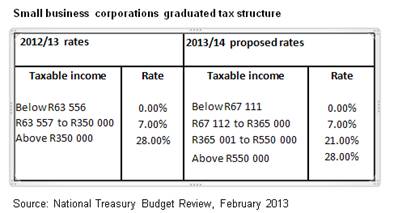
The Treasury also indicated it plans to explore the application of the same rate structure to public benefit organisations’ (PBOs) trading activities. Further, the fiscal authority alluded to the possibility of "special support" for social impact businesses (that have both profit and social objectives) being explored. Other initiatives, outlined in the Budget Review 2013, to promote business development include tax incentives for special economic zones (after consultation with the Minister of Trade and Industry) such as a lower corporate income tax rate, an employment incentive and an accelerated depreciation allowance for buildings located within these zones. Also, government has attempted to respond to the dearth of finance available for small, micro and medium enterprises by establishing the Small Enterprise Finance Agency (SEFA) in April 2012, which aims to provide funding and credit guarantees for SMMEs through partnerships with banks, micro-lenders and commercial banks. However, this initiative is unlikely to make a world of difference in the current environment. To my mind, private sector credit extension - including to small businesses - is likely to remain constrained for an extended period, since lenders are not adequately rewarded for making loans in an uncertain environment, given the current low level of real interest rates. Ultimately, while the tax breaks and incentives announced in the national budget are most welcome, the environment for small and medium enterprises is likely to remain challenging, with funding not readily available - despite low interest rates. Listed small and medium enterprises in South Africa have done well to boost earnings in the aftermath of the "Great Recession", but despite the improvement in productivity, the true potential of both listed and unlisted small and medium enterprises can only be unlocked in the long term by addressing the constraints alluded to above. Written by Arthur Kamp, Investment Economist, Sanlam Investment Management |



Editor: Shane Thom, Silke Financial Services FSP No. 12462 · An Authorised Financial Services Provider Copyright © 2013 by Silke Financial Services CC – All Rights Reserved. |