| ← All communiqués |
|
||
|
4 March 2010
What is 'Equity' and Why is it in My Portfolio? |
||
|
Real return The equity portion in your portfolio represents the ownership you have in a company or range of companies. The reason why it's in your portfolio is because over time (provided the economy is growing) the value of this investment has the best potential of growing at a faster rate than inflation. As an example, you can invest one year's worth of university fees in equities now and have the potential to pay for four years of study at some point in the future as opposed to putting that money into a bank account and still only having the ability to pay for one year of study in the future. The graph below shows that the capital invested on the 1st of January 1960 would now be worth 60 times more than an equivalent investment that matched inflation over the same period. 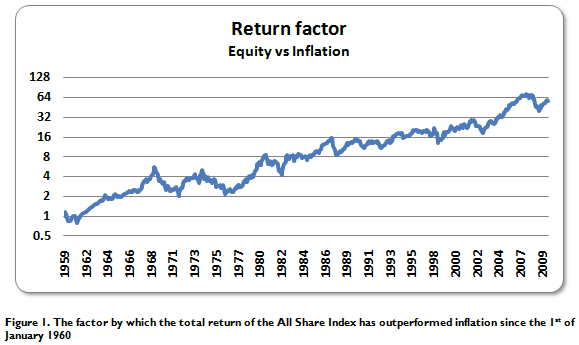
Dividends Just as you receive your salary or wages on a regular basis (which periodically rises either with or in excess of inflation), successful companies declare a tax-free dividend which does the same. What this means is that for a wealthy investor (provided you own a large enough amount of equity) you could rely solely on the declared dividend for income purposes regardless of where the market price happens to be at a point in time. The alternative is to reinvest the dividend into your equity investment to ensure an even higher compounding rate of return. The graph below plots the historic income (dividend) growth for the All Share Index versus inflation. 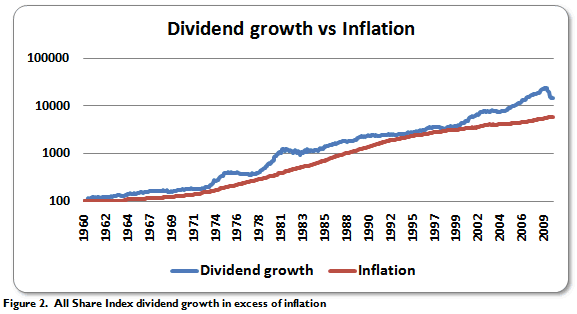
Price Unfortunately the price of the equity investment is what causes the most headaches. We have described the merits of an equity investment from both a real return perspective and a steady real income growth perspective. The flip-side, however, is that equity prices fluctuate wildly which causes stress and uncertainty for highly price conscious investors. Equity investments are relatively easy to make in that only a small amount of capital is required and highly liquid markets exist where transactions can be carried out on a continual basis. As a result of this easy access to markets, investor sentiment and availability of capital can push and pull prices well away from "fair value". Summary An equity investment is essential for achieving an outcome where the value of your current capital has the ability of purchasing substantially more (of a good or a service) in the future than it can currently pay for (e.g. university fees). If you are investing for income, equity has the ability to deliver a steady income which grows in excess of inflation with a capital base that also grows in excess of inflation. Because prices fluctuate wildly, it is recommended that you outsource the management of this investment to a team or organization (via an actively managed private portfolio or unit trust) which ensures that the price you pay for the investment is reasonable or conversely you source a low cost passive investment (index tracking unit trust). Lastly it is recommended that the investment is held for the long-term. The article above was published in the "The Alphen Angle” which is an electronic newsletter of Alphen Asset Management. Silke Financial Services has the skill and expertise to offer a range of funds comprising of asset allocation funds, funds with medium exposure to equity as well as superbly actively-managed full equity funds. |



Editor: Shane Thom, Silke Financial Services FSP No. 12462 · An Authorised Financial Services Provider Copyright © 2010 by Silke Financial Services CC – All Rights Reserved. |